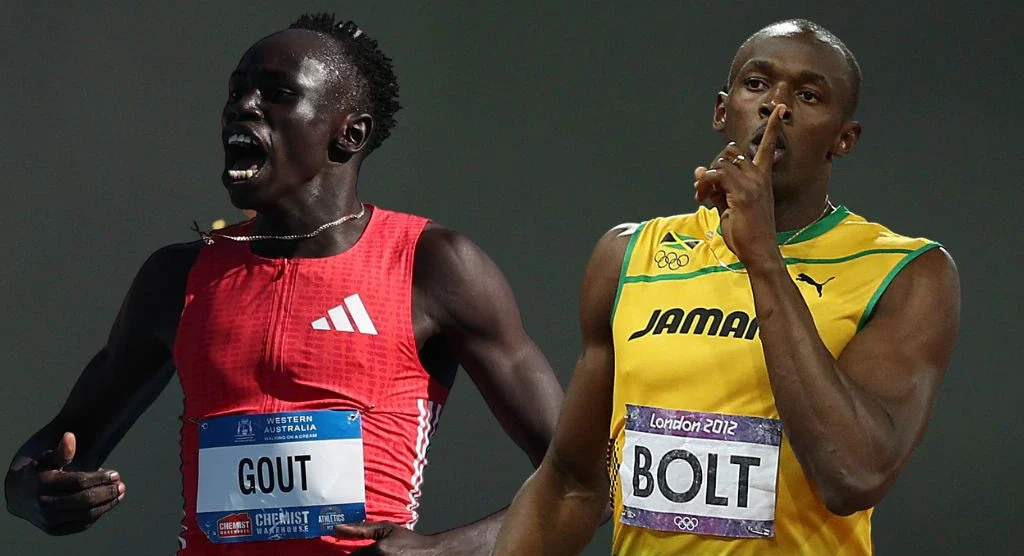
The last 2 weeks have seen 18 year old Australian sprinter Gout Gout back in the limelight after a pair of extraordinary performances that has reignited the debate as to his potential as one of the Athletics greats.
His blistering week started on Sunday 12th of April at the Australian Athletics Championships where he made history in the 200m final, setting a new U20’s World Record of 19.67 seconds. In wind legal conditions, this run saw him break both Erriyon Knighton’s 19.69 record from 2022 and Usain Bolt’s 2004 record of 19.93. Just six days later on Saturday 18th, Gout Gout claimed a second title of the championships with a 10.21 in the 100m final. While he did not break the 10s barrier, instead easing up in the last 30m and waving to the crowd, this run shows that the young runner has plenty left in reserve and that the 10s barrier is not only a realistic goal but one I am sure we will see sooner rather than later.
However, amongst the wins, records and debates, there is one thing from these last performances that stands out to me very clearly: Athletics has not seen a sprinter like Gout Gout since the golden age of Usain Bolt.
Now, there is plenty of discussion that compares these two giants of short sprints; there is no denying the similarity between them when looking at the times they have registered at matching ages and there is certainly valid reason to compare their trajectories. That said, my interest lies not so much in their times or their accolades. No, instead what leads me to draw a serious comparison between the two is the way in which they run.
During his career, Usain Bolt was a biomechanical marvel. From an anatomical perspective, his running style was singular and almost impossibly effective. Standing at 196cm, his build actually made the short sprint a more challenging event for him as he had much further to unfurl out of the blocks in that short amount of time. His shorter, more compact competitors had less work to do and less gravity to challenge in the first 20 meters. However, while they may have been quicker over the first half of a race, almost none of them could match Bolt in acceleration and top speed across the second half of any race.
If we take the example of his record race in the London 2012 100m Final and break it down, you can see how the trajectory of his race differs from those around him. A slow start and slight stumble out of the blocks immediately placed him behind his competitors and by the 20m mark he was in 7th place out of 9. By halfway he had started to make up ground and was back in line with the field, but it wasn’t until the 60-80m segment that Bolt reached his top speed of 12.05m/s (43.38kmph) and pulled ahead. In the last 30m, he stormed away from the rest of the field and gained a significant lead over Johan Blake and Justin Gatlin in 2nd and 3rd place. Despite clocking an Olympic record time of 9.64s, Bolt still eased up slightly in the last 10m showing that, had he continued to sprint through the line, he could have run a time closer to his 9.58s World Record. Regarded as one of Bolt’s best races of his career, I feel it perfectly encapsulates his characteristic race style; slower out of the blocks but accelerating through the second half of the race -reaching top speed relatively late- and pulling ahead in the last 30m; a style that, in spite of certain physical disadvantages in the short sprint, made him ultimately near unbeatable.
Now if we take Gout Gout’s winning 100m race from last weekend and follow the same analysis, the similarity between the two runs becomes undeniably evident. Similarly to Bolt, the race start is not Gout Gout’s strongest suit so, as with Bolt in 2012, Gout Gout came out of the blocks and hit the 10m mark behind his main competitors. By the 20m mark, he was lagging behind Lubenda who had a decent lead. It wasn’t until the 55-60m mark that Gout Gout ran level with Lubenda, just as with Bolt and Gatlin. While I don’t have exact race data for last Saturday, from watching the race alone it is clear that Gout Gout also hit his top speed in the 60-80m segment. By the 80m mark he had pulled ahead of Lubenda and by the 90m mark it was clear that none of the other runners could come close to catching him. Easing up in the final 20m, Gout Gout sailed across the line with a significant lead distance.
These two separate runs, from different decades, demonstrate a remarkable similarity between this rising star and Athletics’ greatest of all time. Especially when you look at the details, it is impossible to deny the parallels between them. Bolt completed the 2012 race in 41.3 strides, averaging a stride length of 2.42m; Gout Gout ran his race with 42.5 strides, averaging a length of 2.35m. Although Gout Gout is shorter than Bolt, he shares the Jamaican’s longer legs which allow him to cycle through at an unusual ground-covering rate; with far longer strides than the average professional sprinter. Even in their posture there is a strong resemblance; staying low out of the blocks with untidier strides to start with, both runners straighten out over the first 50m before running in an upright, relaxed stance where the shoulders drive and power the runners forward. It really is a sight to behold, and a rare one at that.
Watching Gout Gout at the Australian U20 Championships, I found it hard not to see Bolt in him; not for the speed, or the time, or the records broken, but for the form, the biomechanics and the race patterns. There is no doubt that Gout Gout has the potential for a career that could place him in the ranks of sprinting greats if his current trajectory continues. Will he continue to break records in the senior field? Only time will tell, but until then, it is safe to say that I am excited to be witnessing the birth of this rising star; of a potential Bolt reborn, and he is an athlete that I, along with the Athletics world, will certainly keep my eye on.